
Handbound Mixed Media Sketchbook with Hahnemühle Bamboo Paper & Lokta Covers

Manufacturer: Journal Shop
The black-and-white Lokta and the red version looked so good together that I wanted both in the same sketchbook. I used one for the front and one for the back, then kept those colours in the sewing and made a closure to match. Inside, you have 62 pages of Hahnemühle Bamboo 265 gsm for watercolour, drawing and mixed media, in a handbound book that rests open as you work.
€69.00
i h

Every sheet of Lokta carries the artistry of the people who make and print it by hand in Nepal. I wanted its soft surface and the texture of the fibres beneath the pattern to come through in the cover—something for you to enjoy every time you touch it. That was the starting point for this journal.

I brought two colourways of the paper together in one book: black and white at the front, red and black at the back. The pattern and soft texture stay the same, but the colour gives each side its own energy and character.

Then I added the closure: black, with a small red loop on the front. I kept the same two colours in the stitching, red at the front and black at the back. This is one of the things I love about bookbinding: working on the little details until everything comes together into a book with a character all its own!

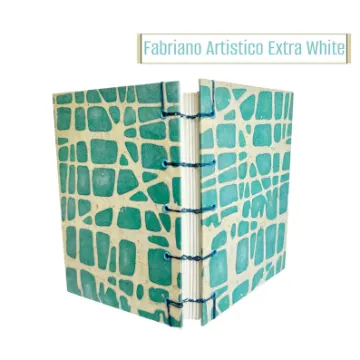
I used Coptic binding to keep the stitching visible and allow the pages to lie flat in front of you. Inside is Hahnemühle Bamboo 265 gsm, a natural-white mixed media paper made from 90% bamboo fibre and 10% cotton, so you can work with wet and dry media in the same book.

🌍 Books of the World

In my Books of the World collection, I work with handmade papers from different places, drawn as much to the people and traditions behind them as to the papers themselves. Many are made using traditional methods. Each paper is the starting point for choosing a binding, threads and other materials. Here, handmade Lokta from Nepal meets the long tradition of Coptic sewing.

📐 Size

  • 13.2 × 18.5 cm / 5.20 × 7.28 inches.

👉 Features

  • Hardcover sketchbook, made and bound by hand.
  • Handmade Nepalese Lokta covers, screen-printed by hand.
  • The same curved black pattern on a pale front cover and a red back cover.
  • Coptic binding with red and black stitching through metal eyelets.
  • Closure made from KraftTex, a tough, leather-like paper.
  • Hahnemühle Bamboo Mixed Media paper, 265 gsm.
  • 62 pages, counting both sides.
  • Natural-white, acid-free paper.
  • Opens flat for working across a spread.
  • Blank pages for portrait or landscape compositions.

👍 Ideal for

  • Watercolour, gouache, acrylic and mixed media.
  • Drawing with graphite, charcoal, pastel and sanguine.
  • Travel sketching, visual notes and keeping a personal artist journal.

✨ Inspiration Tip

A transparent watercolour wash, a deep charcoal line and the soft texture of pastel can all share a page on Bamboo. The same surface supports wet and dry media, so you can change medium without changing paper.

🎁 Included with your book

  • A linen bag for storing and carrying the journal.
  • A certificate of authenticity.

Photo note: Any art materials or styling props shown are for the photographs only.

Hahnemühle Bamboo Mixed Media — 265 gsm

Hahnemühle Bamboo is a mixed media artist paper made in Germany from 90% bamboo fibre and 10% cotton rag. Its combination of a textured surface, natural-white colour and suitability for wet and dry media makes it a versatile paper for work that moves between painting and drawing.

It belongs to Hahnemühle’s Natural Line, a range of artist papers made with renewable plant fibres.

📋 Paper specifications

  • Manufacturer: Hahnemühle, Germany.
  • Paper: Bamboo Mixed Media.
  • Range: Natural Line.
  • Weight: 265 gsm / 265 g/m².
  • Fibre composition: 90% bamboo fibre, 10% cotton rag.
  • Surface: Cold pressed, with a textured finish.
  • Colour: Natural white.
  • Paper quality: Acid-free, lightfast and highly resistant to ageing.
  • Wood fibres: Wood-fibre-free.
  • Vegan: Made without animal-derived raw materials.

🎨 Surface, colour and water

Bamboo has a cold-pressed surface with a visible texture. Colour flows well across the sheet while retaining its brilliance, allowing for both strong contrasts and softer passages.

The bamboo fibres have a high capacity to absorb water, making the paper suitable for wet painting techniques as well as drawing. Transparent washes, opaque colour and dry marks can all become part of the same composition.

The surface also suits opaque painting with gouache and acrylic, including work with full, visible brushstrokes. This gives the paper scope for both fluid colour and more substantial applications of paint.

✏️ Suitable media

  • Watercolour.
  • Acrylic.
  • Gouache.
  • Pastel.
  • Charcoal.
  • Red chalk / sanguine.
  • Mixed media combining painting and drawing.

📚 Paper permanence and quality

Bamboo is acid-free, lightfast and highly resistant to ageing. These qualities support the long-term stability of the paper.

Hahnemühle’s general quality specifications for its Traditional FineArt papers include:

  • Neutral sizing.
  • An alkaline pH between 7.5 and 9.5.
  • A calcium carbonate buffer of at least 4%, helping protect the paper against acidic pollutants.
  • Wood-fibre-free composition.
  • Paper permanence standards DIN 6738, ISO 9706 and ANSI Z39.48-1992.

Lightfastness here refers to the paper itself; the paints and drawing materials used on it have their own permanence characteristics.

🌿 Bamboo, renewable fibres and vegan production

Bamboo is a fast-growing, renewable raw material. Hahnemühle introduced bamboo artist papers in 2008, developing the range as part of its work with alternative plant fibres.

The paper is vegan, with no animal-derived raw materials. Its sizing uses synthetic compounds rather than gelatine-based animal glues.

Through its Green Rooster initiative, Hahnemühle contributes a share of the proceeds from Natural Line papers to environmental and social projects.

📄 Nepalese Lokta Paper

What draws me to Lokta is the texture beneath the pattern. Even with a bold design printed over it, the fibres still give the surface a character of its own. Before I begin making a book, there is already something here worth spending time with.

Handmade in Nepal from the fibrous inner bark of Daphne shrubs, Lokta is formed one sheet at a time. Its strength comes from the fibres; much of its beauty comes from the hands that work them.

📜 A tradition carried forward

For centuries, Lokta has held words that people wanted to keep. Hand papermaking in Nepal is documented from at least the twelfth century, and the paper’s durability made it a valued material for religious manuscripts and official records.

Imported, machine-made papers later reduced demand for the traditional craft. During the late twentieth century, efforts to revive local papermaking and a growing international interest in handmade paper helped bring it to new audiences. The tradition continues through the people who practise it.

🤲 One sheet at a time

Turning bark into paper takes water, sunlight, patient work and a practised understanding of the fibres.

  • The inner bark is cleaned, soaked and cooked to soften it. Traditional methods use an alkaline solution prepared with wood ash.
  • The softened fibres are washed and beaten with water to produce pulp.
  • A papermaker spreads the pulp across a fine mesh held in a wooden frame, forming each sheet individually.
  • The water drains away, and the frame is left in the sun. Once dry, the sheet is carefully lifted from the mesh.

Every sheet has its own arrangement of fibres and its own feel under the hand. The colour and pattern added later become another part of that character.

🤝 The people behind the paper

Behind a finished sheet are people who gather bark in the mountain forests, prepare fibres, form paper, mix colour and print patterns. Their work connects forest communities and village papermakers with dyeing and printing workshops, including those of the Kathmandu Valley.

Lokta production provides income for many families, with women playing a significant role in the work. The knowledge involved is practical and precise: knowing which stems to collect, how the pulp should feel, how to distribute it across a frame, how to place the next impression.

The shrubs can regenerate after their stems are cut, provided their roots are protected. Careful harvesting and sufficient time for regrowth are essential to maintaining this renewable source of fibre.

🎨 Colour and pattern, applied by hand

The Lokta papers I choose for my covers are decorated in several ways. Each technique leaves a different impression on the surface.

  • Screen printing / silkscreen: Ink is drawn through a stencilled mesh screen onto the paper. Multicoloured designs can be built up in separate layers, carefully positioning the sheet for each impression.
  • Batik: Wax is applied to selected areas before dye is added. The wax preserves the colour beneath it by resisting the dye. Patterns can develop through successive applications of wax and colour.
  • Block printing: A carved wooden block is inked and pressed onto the paper by hand. The pattern grows across the sheet through repeated impressions, each placed by the printer.

🪡 From their hands to mine

By the time a sheet reaches my workbench, other people have already given it their time, attention and skill. I think about that when I choose how to make it into a cover.

In my Books of the World collection, the paper is where each book begins. Its texture and pattern guide my choices of binding, thread and other materials. I want those qualities to remain present in the finished book, where the papermaker’s work and my own become something you can hold in your hands.

*
*
*
Product tags